


UGANDA – Sometimes you don’t have to look far for a solution: nature itself can remedy less favourable conditions for ‘water and soil’. Agroforestry is one such nature-based solution. Our partner, KFF (Kyaninga Forest Foundation), is promoting it amongst cocoa and coffee farmers in the Kabarole district, west of Fort Portal.
Agroforestry – the combination of trees and shrubs with arable farming, livestock rearing or horticulture – improves soil and water conservation, strengthens river buffer restoration, and enhances the resilience of the upper Mpanga catchment. This boosts the resilience of both people and nature, whilst agricultural yields increase.
Cocoa and coffee
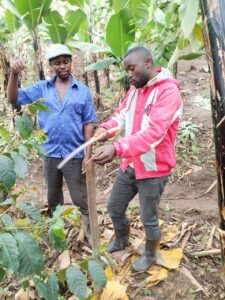
Specifically, KFF works with cocoa farmers in Bundibugyo and Arabica coffee growers in the Karangura sub-district. KFF provides the farmers with native tree species and gives them practical training in agroforestry.
In Bundibugyo, cocoa thrives best under shade. By integrating indigenous trees into cocoa farms, KFF supports farmers to create a favorable microclimate that protects crops from excessive heat, stabilise river banks, reduces moisture loss, and improves overall plant health.
Similarly, in Karangura Sub-County, where Arabica coffee is widely grown, shade trees help regulate temperature, shield coffee plants from harsh sunlight, and enhance bean quality.
Trees with added benefits
Trees provide even more beneficial effects:
- falling leaves decompose into organic matter, enriching the soil naturally
- and improving moisture retention,
- reducing dependence on chemical fertilizer,
- deep tree roots stabilize the land, and
- prevent erosion on hilly farms,
- the increased biodiversity supports natural pest control.
Pruning rather than felling
Agroforestry also generates additional income for farmers through the sale of extra products such as fruit, timber and firewood.
At Kyaninga Forest Foundation (KFF), pollarding is promoted as a practical and sustainable tree management practice that benefits both farmers and the environment. Rather than cutting down entire trees for firewood, farmers are trained to carefully prune upper branches, allowing them to harvest fuelwood regularly while keeping the tree alive and productive.
This approach ensures that trees continue to provide essential services long after the first harvest. At the same time, farmers meet their household energy needs without degrading their land or reducing tree cover.
By encouraging controlled pruning instead of tree felling, KFF promotes long-term sustainability as farmers are able to benefit repeatedly from the same tree, harvesting firewood, mulch, and other materials while preserving its environmental and economic value. In this way, pollarding strengthens livelihoods, protects natural resources, and ensures that today’s needs are met without compromising the future.
By linking environmental conservation to better living conditions, KFF demonstrates that productive farms and healthy ecosystems can coexist perfectly well.
Read other stories about landscape restoration: